Basement Flooding Cleanup in Boston, MA
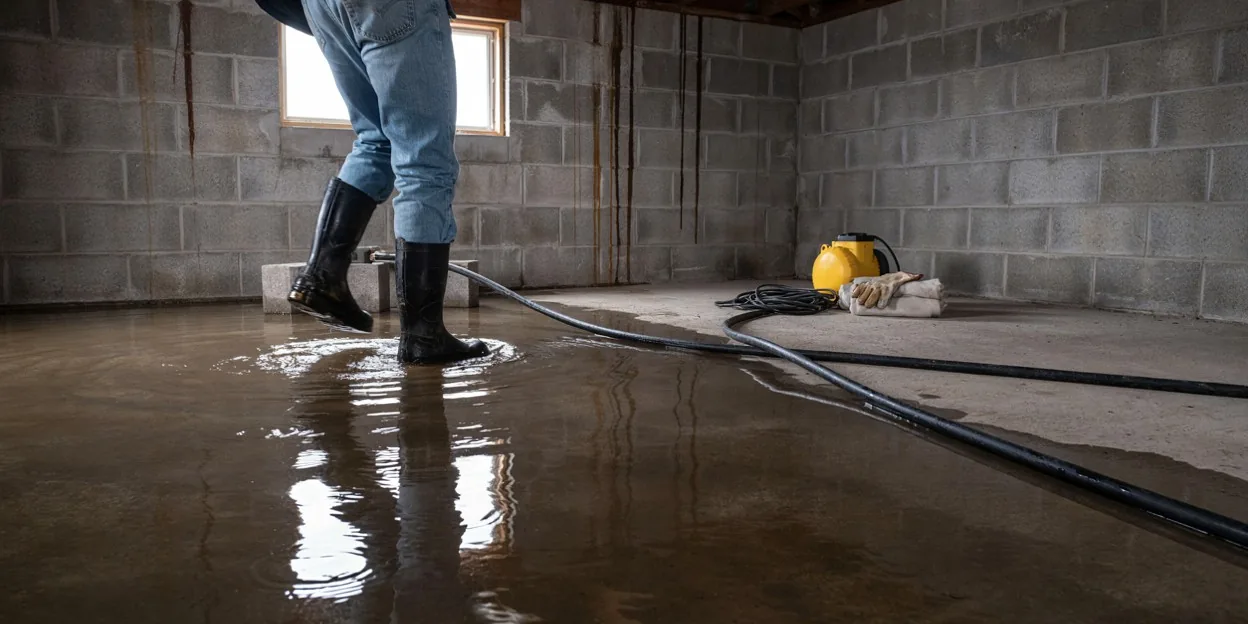
It rained all night, the snowbanks on the sidewalk turned to slush, and this morning the basement rug is floating. The water is coming in at the corner where the fieldstone meets the slab, and it is coming up through the floor drain too. Call us now and tell us what you see. An independent local provider who handles basement flooding cleanup in Boston and the inner-ring cities takes it from there.
What the crew does first
The crew looks at the water before they touch it. Groundwater seeping through the wall is one thing. Water that came up the floor drain from a combined sewer is another, and it gets protective gear and contained disposal. Street water off a flooded road is treated the same way. That call shapes the whole job.
Then they pump. Deep water goes out with a submersible pump, the last inch with extractors. Wet contents get moved into a sorted pile: keep, dry, or discard. Finished walls are metered at the base, and wet paneling, drywall, and insulation are cut back to where the readings go dry. Carpet and pad usually come up. Then air movers and dehumidifiers go in, and the crew checks the readings daily.
What to do in the next hour
Stay out of the water if the electrical panel is in the basement and the water is near it. Shut off the circuits from a dry spot if you can, or wait. If the water came up a drain, stop running water in the house so you do not add to it.
Do not throw anything out yet. Photograph the water line on the walls and the boxes sitting in it. Move what you can carry up the stairs. If the sump pump has stopped, say so when you call, because that becomes a sump pump failure cleanup and a plumber visit at the same time.
What is usually saved and what is not
Concrete, stone, brick, and metal shelving can be cleaned and dried. Framing and subfloor above a flooded slab usually dry in place if the water was clean and the crew gets to it within a couple of days. Tools, solid wood furniture, and sealed plastic bins come through fine.
Cardboard, carpet pad, particleboard, upholstered furniture, mattresses, and paper do not. If the water came through a sewer drain or off the street, anything porous it touched is removed, and the job overlaps with sewage cleanup. Ask before the crew carries something out and photograph it first. Once the contaminated material is gone and the bulk water is out, structural drying finishes the job.
Suffolk County notes: why Boston basements flood
The cellars here were dug by hand in the 1880s through the 1920s, with fieldstone or brick walls laid in lime mortar. When the ground outside is saturated, water pushes through the joints, and a slab poured decades later does not stop it. Downspouts that dump next to the foundation, window wells that fill with leaves, and a driveway pitched toward the house all feed the problem.
Then the sewer. Boston, Cambridge, Somerville, and Chelsea still carry stormwater and sewage in the same pipes across much of the older street grid. In a hard rain those lines fill, and the water looks for the lowest opening, which is often a floor drain or a basement toilet on a low street in Dorchester, Roxbury, or East Cambridge. Spring melt after a heavy winter does the same thing more slowly. The record snow of 2015 left basements across the region taking on water for weeks once it started to thaw.
Many policies exclude groundwater and sewer backup unless a rider was added, and flood insurance is a separate policy. Ask the crew to record the source, the water line, and the first readings so your adjuster has the facts.
Calling about basement flooding cleanup
Say how deep the water is, where it seems to be coming from, and whether it came up a drain or through the wall. Mention a finished basement, a furnace or panel in the water, and whether the sump pump is running. Call (857) 524-9927 now and tell us what you see.